Private Label Rugs: How Brands Source from an Indian Manufacturer
Private label rug manufacturing allows retail brands and designers to sell custom-designed, factory-direct carpets under their own brand name. Indian manufacturers in hubs like Mirzapur provide the infrastructure—handling CAD design, raw material sourcing, dyeing, weaving, and blind shipping—while the buyer retains complete brand ownership. This B2B model ensures high margins, exclusive product lines, and scalable inventory without the overhead of operating a textile factory.
What is private label rug manufacturing?
How does the private label model work?
In a private label agreement, an overseas brand contracts an Indian manufacturer to produce a line of rugs based on specific designs, materials, and quality standards. The manufacturer produces the goods, but instead of applying their own tags, they attach the buyer's custom branding, labels, and packaging. The brand then markets and sells these rugs as their own exclusive collection. This is a common practice among high-end e-commerce retailers, boutique design firms, and large home décor chains. Explore our Private Label & OEM Services.
What are the core benefits for retail brands?
The primary advantage is brand control and exclusivity. Retailers are not selling generic inventory available to their competitors; they are building brand equity through unique designs. Secondly, sourcing factory-direct eliminates wholesale middlemen, significantly increasing profit margins. Finally, partnering with an established manufacturer provides access to scalable production capacity, allowing a brand to grow from initial strike-off samples to full container-load (FCL) programs without capital investment in looms or artisan training.
How do brands develop a private label collection?
Why is the strike-off phase critical?
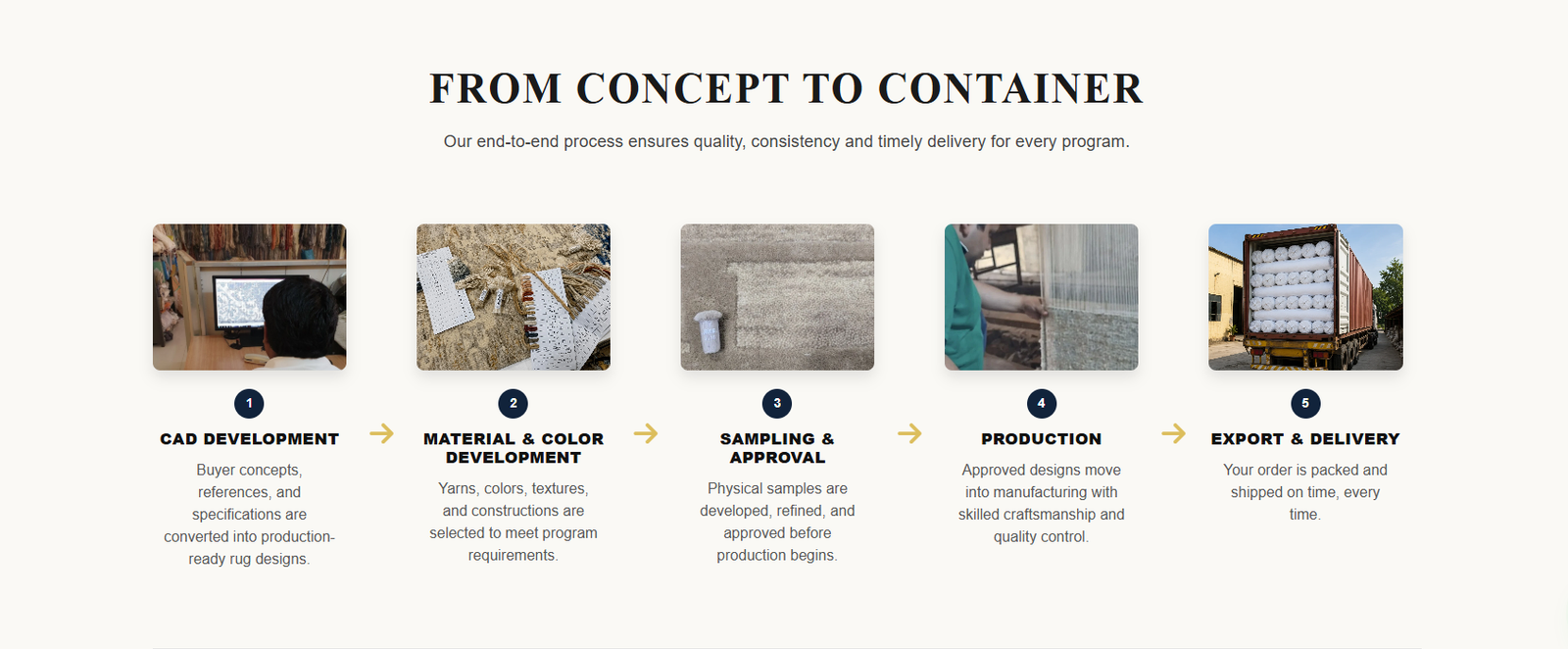
The strike-off is a small physical sample (typically 2x2 ft) produced before bulk manufacturing begins. It serves as the definitive proof of concept. Brands must carefully evaluate the strike-off to confirm that the chosen fibres (e.g., New Zealand wool vs. bamboo silk) feel correct, the pantone colours match the intended palette, and the knot density or tufting style yields the desired texture. Approving the strike-off formalizes the production standard.
How is brand confidentiality maintained?
A professional OEM (Original Equipment Manufacturer) operates as a silent backend partner. This involves strict confidentiality agreements (NDAs) to protect the brand's proprietary designs. Furthermore, the manufacturer ensures "blind shipping"—meaning the commercial invoices and packing lists visible to the end consumer or retail warehouse contain only the buyer's branding, with no consumer-facing trace of the Indian factory.
What should brands consider when selecting an Indian partner?
How do you verify manufacturing capability?
When launching a private label line, brands must verify that the factory can handle the required volume and complexity. Do they have the capacity to weave oversized Hand-Knotted Rugs? Can they execute rapid-turnaround Hand-Tufted programs for trend-driven collections? Brands should review the factory’s infrastructure, from their raw material sourcing and in-house dyeing facilities to their finishing processes and quality control protocols.
Why does ethical production matter?
Modern consumers demand transparency and ethical sourcing. Brands must partner with manufacturers who comply with international labour standards, provide safe working conditions, and adhere to environmental regulations (such as responsible dye disposal). Sourcing from factories registered with regulatory bodies like the Carpet Export Promotion Council (CEPC) protects the brand's reputation.
Frequently Asked Questions
What is the minimum order quantity (MOQ) for private label rugs?
MOQs vary significantly by construction. Hand-tufted or flatweave programs often require higher volume commitments (e.g., 500 sq meters), while bespoke hand-knotted pieces can sometimes be ordered with zero MOQ for high-end designer trade programs.
Can the manufacturer handle custom packaging?
Yes. A full-service OEM partner will attach your custom woven labels to the rug backing and can utilize specific poly-wrap or branded carton packaging as required by your warehouse receiving guidelines.
How are designs protected from being copied?
Reputable manufacturers operate under Non-Disclosure Agreements (NDAs). Your custom designs remain your intellectual property and are not sold to other clients or displayed in the manufacturer's generic catalog.
How long does it take to launch a private label collection?
From initial concept to receiving the first container, the process typically takes 4 to 6 months. This includes CAD development, strike-off approval (30-45 days), bulk production (60-120 days depending on construction), and ocean freight.
Does Shukla Brothers offer private label manufacturing?
Yes. We serve as the silent manufacturing partner for leading home decor brands and hospitality suppliers worldwide. Contact our Export Division to discuss your collection.
Editorial Gallery